Besides eating turkey and gathering with your family to celebrate what you are thankful for, shopping online or in stores has become a major part of our Thanksgiving holiday. The words “Black Friday” and “Cyber Monday” quickly become the most mentioned words during a conversation between two housewives during this holiday season.
What exactly are the terms “Black Friday” and “Cyber Monday”? The term “Black Friday” usually refers to the Friday after Thanksgiving, known as the first day of Christmas shopping. On “Black Friday,” retail stores carry out good deals and promotions to attract customers in an effort to increase sales. The term “Cyber Monday” refers to the first Monday after Thanksgiving, created in 2005 by a marketing firm in order to carry on the tradition of shopping in stores on Black Friday to shopping online that following Monday.
The difference between “Black Friday” and “Cyber Monday” is more than one occurred on Friday and another occurred on Monday. “Cyber Monday” mainly focuses on online shopping and targets female in the work force. When the term “Cyber Monday” was first introduced, it was ranked as the 12th busiest online shopping day of the year. However, 10 years later, it has already become the biggest and busiest online shopping day of the year. “ This year, 2015, it is estimated to 3 billion total in sales, which is a 12% increase over 2014, surpassing “Black Friday”, which is estimated to generate 2.7 billion in online sales, according to Adobe Digital Index” (Bonewright)
When listing out the websites to visit on “Cyber Monday”, Target appeared to be the top choice of many online shoppers since the store offered 15 percent off of any items online. Shopping should always be a fun and engaging experience; however, for some shoppers who shopped on the target website, it turned out to be an unpleasant shopping experience. Due to the high traffic and demand online, the Target website stopped working for some customers when they tried to add items to their carts. When customers tried to add certain item to their carts, a message pop up on their screen indicating that there is a waiting line for that product and the customer needed to wait patiently or continue to refresh the page.
Target faced massive amounts of complaints and a new hashtag #targetfail was created on twitter. A representative told WIRE magazine, “The volume of traffic today is double the site’s previous record, set three days ago on Black Friday.” The spokeswoman said that while the site hasn’t crashed per se, the company has been “metering” the site’s traffic since 9am CST, when the company saw its biggest spike. (Greenberg)
Although the term “Cyber Monday” was originally created by a marketing firm in order to boost sales for certain retailers, it has become one of the most significant online shopping day for the United states and seen as a prominent trend for online retailing business.

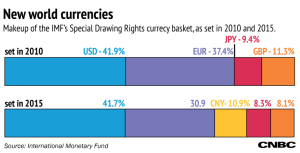 The British pound was the original IMF global reserve currency, until the U.S. dollar surpassed it in the 1920s. CNBC data journalists say since 2010, the pound has held 11 percent of the special drawing rights. However, the eventual addition of the yuan could reduce its holdings to 8 percent. The euro will most likely deal with an even greater loss. When the European union joined in 1999, the euro quickly gained ground accumulating over 37 percent of the special drawing rights by 2010. Now, the yuan could force the currency to reduce its shares for the first time by 6.5 percent. Both of the major currencies in Europe could be facing some stiff competition in the near future as more countries start adding the yuan to their reserve funds. As for the U.S. dollar, it seems like it will continue as the dominant global currency.